From Embers to Tandoor: The Evolution of Skewered Kebab to Its Present Form
When examining recipes for the many robust flavours of Anatolian cuisine, ingredients vary. One city uses lamb, while another favours minced meat. In one place, aubergine takes centre stage; elsewhere, it is pepper or tomato.
Yet, behind the tables, one element has remained unchanged for centuries: fire.
It manifests on a skewer placed over smoldering wood, in a tandır dug into the earth, or within the skin of a gently charred aubergine. In Anatolia, fire is not merely a heat source for cooking. It is a culinary technique that determines a dish’s texture, aroma, cooking time, and often its regional origin.
Today, when we discuss the history of kebab in Anatolia, what tandır is, the culture of cooking over embers, or fire in Turkish cuisine, we must first grasp this fundamental relationship that predates thousands of recipes.
In Turkish Cuisine Why Is Fire So Important?
To read traditional Anatolian cuisine solely through the names of its dishes would be incomplete.
Academic studies of culinary culture note that the Turks cooked meat and offal in tandırs made from earth, or turned them directly over an open flame. The tandır was also used not only for meat but for preparing staple foods such as lavaş and tandır bread.
For this reason, the culinary culture that developed around the fire does not belong to a single group of dishes.
Bread is there, too.
Meat, too.
Vegetables, too.
As does the cauldron in which the soup simmers.
As do the preparations for winter.
Although stoves, ovens, and modern kitchen equipment have changed over time, this relationship forged over fire endures in many regional recipes across Anatolia.
What Is Charcoal Grilling? Why Does Flavour Persist Once the Fire Dies Down?
When the flames subside and the wood or charcoal becomes embers, a wholly different cooking environment emerges in the kitchen.
The most important quality of charcoal grilling is its ability to deliver controlled, intense, and direct heat.
When vegetables such as aubergine, pepper and tomato meet the embers, they do not merely soften. The scorched marks that form on their skins and the smoky aroma developed through contact with the fire completely transform their flavour.
This is precisely why the culture of charcoal-grilling occupies a distinct place in Anatolian cuisine.
Why Does Grilled Aubergine Appear So Frequently alongside Kebabs?
Aubergine is among the most commonly used vegetables alongside meat in Anatolian and neighbouring cuisines.
Yet what renders it distinctive is not merely its harmony with meat.
Grilled aubergine acquires a soft, lightly smoky and dense texture. This quality particularly balances the robust flavours of lamb and kebabs.
In the official cultural publications of Gaziantep cuisine, Alinazik, aubergine kebab, vegetable kebab, and various minced- and diced-meat kebabs are all situated within the same broad kebab culture, demonstrating the diverse ways in which vegetables and fire-cooked meat can be combined.
Söğürme: One of the Finest Examples of Ember Culture at the Table

The term “Söğürme” evokes a method of preparation in Anatolian cuisine, particularly associated with vegetables cooked over charcoal.
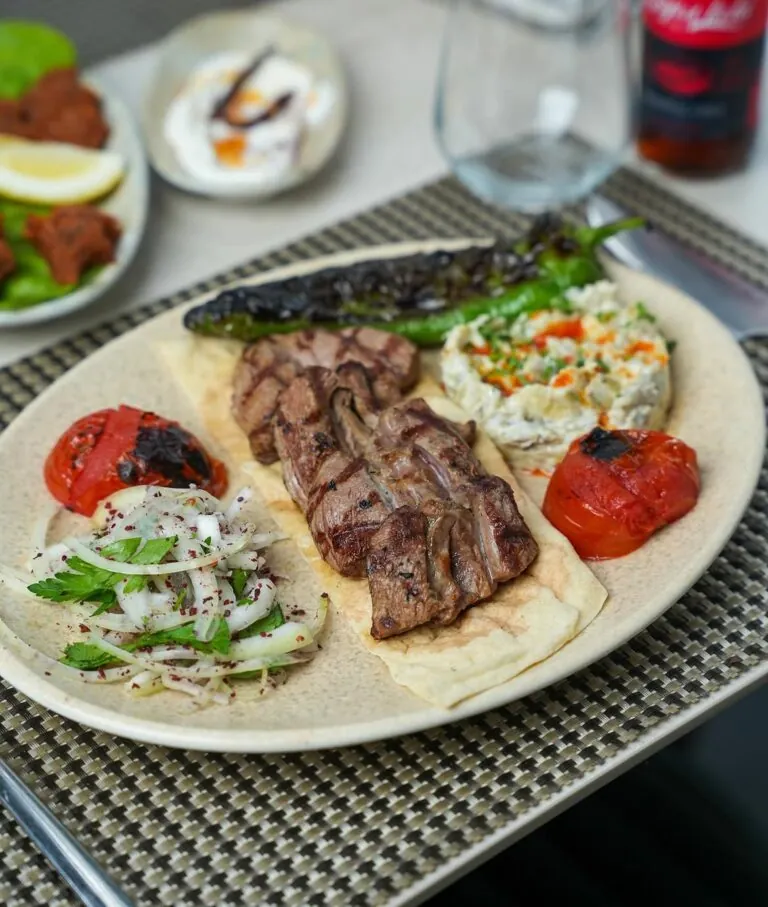
Charring eggplant over an open flame, peeling its skin, and serving it alongside meat imbues the dish not merely with vegetable flavour but also with the character of the charcoal.
In Çakı Restoran’s own culinary narrative, Söğürme Kebabı is described as a dish where the smoky aroma of charred eggplant meets meat. On the restaurant’s current main-menu offerings, Söğürme Kebabı is priced at 880 TL and appears under “Chef’s Choice”.
What Is a Tandır?
When the term tandır is mentioned today, most people think of tender lamb that has been slow-cooked for an extended period.
Yet tandır is not merely the name of a dish; it is, in fact, a cooking environment.
In traditional examples, a fire is lit in a tandır oven constructed in the earth or on the ground. Once the fire has turned to embers, the food is cooked by the intense heat generated within the tandır.
A recipe for tandır kebab included in the resources of the Ministry of Culture and Tourism describes how, after a fire of oakwood has turned to embers, the meat is threaded onto a hook, suspended inside the tandır, and the tandır is then covered.
Here, the meat is not placed directly into the flames.
The essential process takes place through the heat accumulated within the tandır.
Why Is Time the Secret of the Tandır?
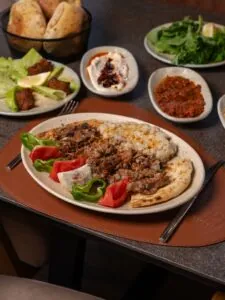
It is not possible to prepare a small piece of meat cooked on a skewer using the same technique as a large cut of lamb.
Large cuts of meat with strong connective tissue require time to soften.
The enclosed structure of the tandır, combined with controlled heat and a prolonged cooking period, allows the meat to gradually tenderise in its own fat and juices.
In Bitlis’s traditional büryan preparation, a distinct interpretation of this process emerges. Once the tandır’s fire has turned to embers, a vessel filled with water is placed inside, and the meat is suspended from hooks so that it does not touch the water. Within the sealed tandır, the meat cooks both by the heat of the fire and by the steam that forms.
The same basic tool can evolve into different techniques across different regions.
This is one of the finest aspects of Anatolian cuisine’s diversity.
Why Does Skewer Cooking Remain One of the Most Recognised Methods of Preparing Kebab?

The tandır demands patience.
Şiş, by contrast, establishes a more direct relationship with the fire.
The meat must be cut into small, uniform pieces, threaded correctly onto the skewer, and the distance between it and the embers must be continuously monitored.
For a fine şiş kebab, the quality of the meat alone is not enough.
The Size of the Meat Matters
If the pieces on the same skewer vary in size, some may dry out while others remain undercooked.
Distance from the Flame Matters
If the meat is brought too close to the coals, its surface may burn rapidly. If it is held too far away, however, the desired seared crust and smoky aroma may fail to develop.
Turning Is Important
Turning the skewer is not merely a matter of cooking all sides of the meat. Controlling the heat and ensuring an evenly browned surface are also part of the craft.
For this reason, lamb skewer is one of those dishes in which the skill of managing the flame is directly perceptible, despite the apparent simplicity of its ingredients.
Why Do Minced and Diced Meat Behave Differently Over Fire?
As kebab traditions developed, minced meat joined whole cuts and diced meat in cooking over fire.
This change was more than a matter of shape.
For minced-meat kebabs, the fat content, kneading technique and ability to hold onto the skewer are essential. For diced-meat kebabs, the cut and degree of cooking play a greater role.
Even when the same skewer is used, the approach to cooking is therefore quite different.
For a skilled kebab master, knowing when to turn the skewer by observing the fire, when to move it away from the heat, and how long each cut of meat requires is as valuable as the recipe itself.
In Eggplant Kebab, the Fire Manages Two Ingredients Simultaneously

In kebabs where meat and eggplant are placed on the same skewer or arranged for cooking together, the task becomes somewhat more challenging.
This is because meat and vegetables do not cook at the same rate.
While the eggplant needs to soften, the meat must not lose all its moisture. The meat’s fat transfers to the vegetables, while the vegetables’ moisture and aromas, in turn, alter the kebab’s overall character.
Thus, the fire does not merely cook two distinct ingredients; it also enables them to impart flavour to one another.
Çakı Restoran’s current main-course menu lists Patlıcanlı Kebap at 890 TL.
In Geleli Kebab, the Fire Defines the Dish’s Character Rather Than the Meat Directly
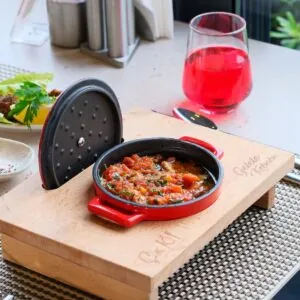
Geleli Kebab, one of Malatya cuisine’s distinctive dishes, offers a fine example of differing applications of fire converging on a single plate.
Here, the grilled aubergine forms one of the dish’s foundational elements, while the meat, tomato and pepper undergo a separate cooking process.
The result differs considerably from the classic shish kebab.
In other words, conceiving the term “kebap” solely as meat roasted over an open flame on a skewer is insufficient to account for the diversity of Anatolian cuisine.
Çakı Restoran’s current menu lists Geleli Kebabı at 950 TL.
From Charcoal to Tandır: The Same Fire, Different Results
When we juxtapose the methods of fire-cooking across Anatolia, an intriguing picture emerges.
Over coals, vegetables or meat are transformed by the aromas generated by direct, intense heat.
On skewers, the distance between the ingredients and the flame, along with constant turning, becomes crucial.
In a tandoor, the enclosed environment and time come into play.
On a griddle, the hot metal surface transfers heat directly to the food.
In an oven, ambient heat ensures a more balanced cooking process.
The Ministry of Culture and Tourism’s records of traditional kebabs also list sac kebab, sini kebab, and various other fire-based techniques alongside tandır kebab, demonstrating that the term “Anatolian kebab” cannot refer to a single method alone.
Kebap History Is, in Fact, a History of Cooking Techniques
Consequently, the history of kebabs in Anatolia is not confined to investigating which kebab originated in which city.
It is also the story of how people learned to control the fire at their disposal.
A pit was dug in a certain place, and a tandır was built.
In another place, meat was threaded onto skewers.
In yet another region, a saj was used.
Vegetables were placed directly over the embers.
As geography, livestock, available fuels, and daily lifestyles changed, so too did cooking techniques. Academic studies examining the richness of Anatolian culinary culture also reveal that this diversity was shaped by geography, history, and the accumulated traditions of various communities.
Has the Tradition of Fire Been Lost in the Modern Restaurant Kitchen?
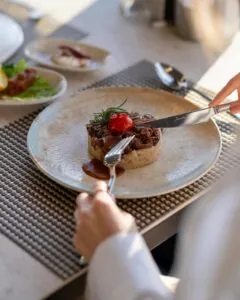
In today’s restaurant kitchen, equipment has naturally changed.
Heat can now be measured more easily, cooking times managed with greater control, and kitchen standardisation has become far more important.
Yet the same questions are still asked of a fine kebab:
At what temperature should the meat be cooked?
When should it be turned?
How intense should the embers be?
How thoroughly should the aubergine be charred?
At what point is meat from the tandır tender enough?
Technology can make the answers to these questions more precise, but it cannot entirely remove the need to understand the fire.
This is also where craftsmanship continues to thrive.
In Başakşehir, Embers, Skewers, and Tandoor Come Together on a Single Menu
For those seeking Anatolian cuisine in Başakşehir and regional dishes in Başakşehir, these ancient cooking techniques need not be confined to history books.
Today, Anatolia’s different traditions of cooking with fire can sit alongside one another on the same restaurant menu.
Several fine examples can be found on Çakı Restoran’s current main-course menu:
Söğürme Kebab is listed at 880 TL, Geleli Kebab at 950 TL, Aubergine Kebab at 890 TL, Lamb Skewers at 980 TL and Lamb Tandır at 990 TL. As menus and prices may change over time, it is worth checking the current menu before your visit.
What unites these dishes is not merely the meat.
In one, the embers take centre stage.
In the other, the skewer.
In one, the tandır’s philosophy of slow cooking.
In another, the union of aubergine and fire.
The Continuation of Anatolia’s Fire Tradition in Başakşehir
It is not right to judge a restaurant’s connection to Anatolian cuisine merely by counting how many kinds of kebab appear on its menu.
The true distinction emerges in how markedly the cooking traditions of different regions can be felt at the table.
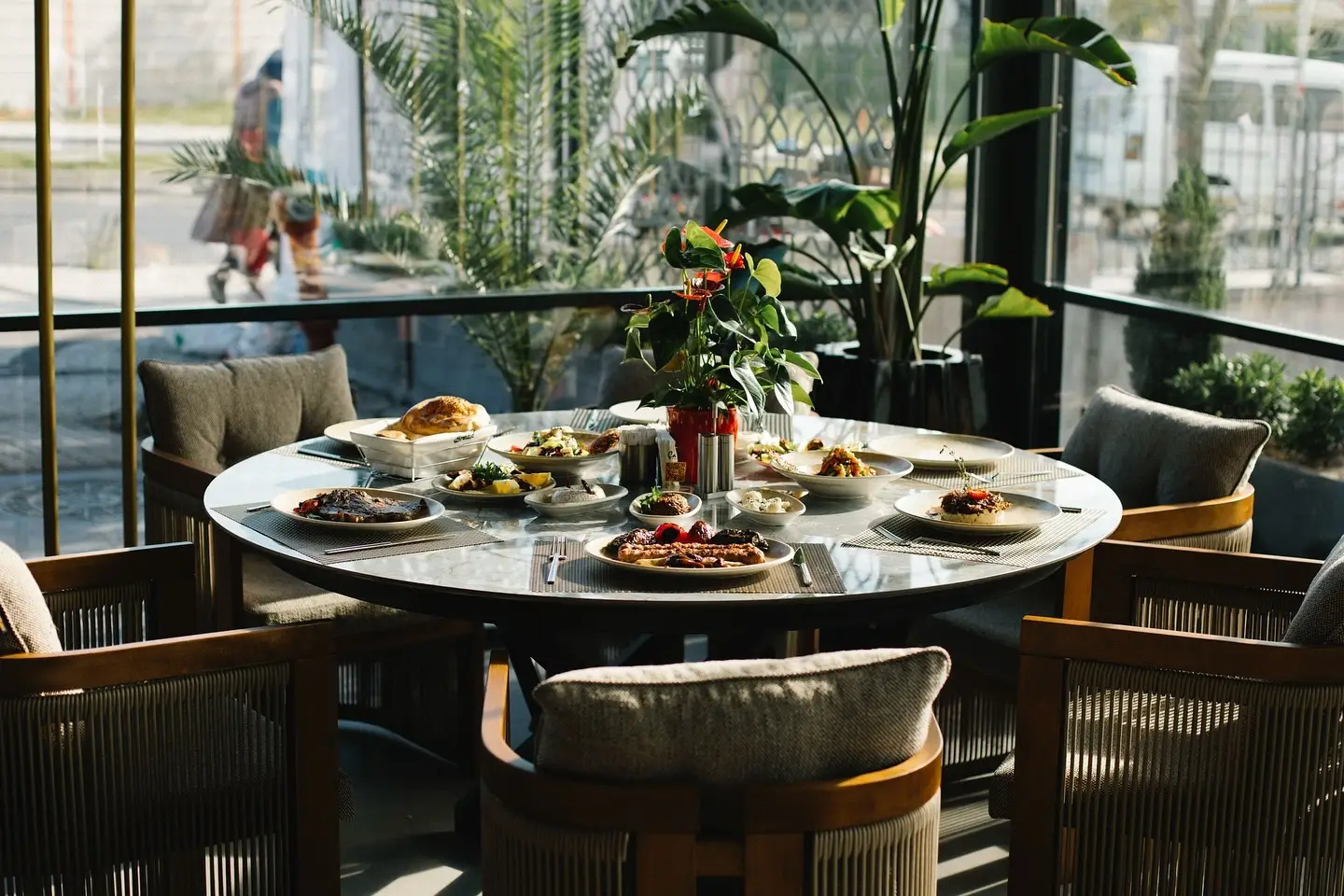
Çakı Restoran’s approach—“From breakfast to kebab in Başakşehir, the leading destination for Anatolian cuisine”—acquires particular significance in this context. The menu, which extends from the breakfast spread beginning in the early hours to dishes cooked over embers, from skewers to tandır, serves as a reminder that Anatolian cuisine is not confined to a single category of dishes. Çakı’s current menu presents kebabs, oven-baked dishes, breakfast options, and a range of main courses alongside sections devoted to Malatya and Kayseri.
For those who wish to gather with family over a warm meal on Istanbul’s European Side, introduce visitors from outside the city to regional Turkish cuisine, or experience diverse cooking techniques among Başakşehir’s regional dishes at the same table, this variety transforms a mere evening plan into a brief journey through Anatolia.
For certain dishes, their story is understood not by examining the plate, but by tracing the origin of the fire.
In Anatolia, that fire has never died out. It has merely changed form.
Frequently Asked Questions
What is a tandır?
Tandır is a traditional cooking hearth constructed in the earth or ground, where fire is kindled to generate high heat. It has been used not only for meat dishes but also for preparing products such as lavaş and tandır bread.
How is tandır kebab cooked?
Although methods vary according to the region, in one of the traditional examples documented by the Ministry of Culture and Tourism, once the tandır fired with oakwood has become embers, the meat is suspended on a hook, the tandır is covered, and the cooking proceeds.
Is cooking over embers the same as grilling?
Not quite. Embers are the flameless but intensely hot remains of burnt wood or charcoal. Grilling, by contrast, refers to cooking food on a specific apparatus above a heat source. Embers can serve as the heat source for grilling, but vegetables may also be cooked directly over them.
Lamb on the skewer—why is the fire important?
Because the meat on the skewer is positioned close to the heat source, the fire’s temperature, the distance between the fire and the meat, and the timing of the skewer’s rotation all directly affect both the degree of doneness and the aromas that develop on the surface.
Is kebab merely a single cooking technique in Anatolia?
No. The Ministry’s records of traditional cuisine document numerous examples of kebab prepared using tandır, sac, sini, şiş, and various regional methods.
Does Çakı Restoran offer tandır and skewer dishes?
Yes. Çakı Restoran’s current main course menu lists Lamb Tandır and Lamb Şiş. The same menu also features dishes that represent fire and charcoal culture in different forms, such as Söğürme Kebab, Geleli Kebab, and Eggplant Kebab.