
The Unsung Hero of Anatolia’s Baking Culture
The most substantial dishes of Anatolian cuisine do not always emerge from grand banquet tables.
Sometimes, the story begins in a neighbourhood bakery that fires up early in the morning.
Dough prepared at home, together with cheese, minced meat or a vegetable filling, makes its way to the oven. The oven’s high heat, the baker’s peel and a few minutes of waiting eventually produce that familiar aroma of bread, which spreads throughout the entire neighbourhood.
Malatya-Style Cheese Bread embodies precisely this sense of Anatolia.
The union of thin dough and cheese, baked at a robust oven temperature, may at first glance appear exceedingly simple. Yet behind this simplicity lie Malatya’s expansive bread culture, Anatolia’s shared baking traditions, and bread’s indispensable place at the everyday table.
So why should Malatya cheese bread not be regarded as merely another cheese pide, and why do neighbourhood bakeries hold such significance within Anatolia’s table culture?
Why Is Bread Central to the Table in Malatya?
Malatya cuisine is rich not only in kebabs, bulgur dishes and recipes made with apricots.
The city’s bread culture is equally extensive.
In the records of Malatya Metropolitan Municipality concerning local culinary traditions, numerous distinct types of bread are mentioned, including yufka bread, tandır bread, ekşili bread, kınalı bread, tablama bread, bazlama, yağlı bread, and pağaç.
This diversity conveys something significant:
In Malatya, bread is not merely a complementary item placed at the table alongside a meal.
It is a culinary culture in its own right.
The thickness of the dough varies.
The cooking method varies.
The tandır is used, the sac is used, and the oven comes into play.
Sometimes it is prepared simply, and at other times it is enriched with fat or various other ingredients.
Malatya-Style Cheesy Bread is one of the contemporary interpretations of this extensive dough and baking culture that survives to this day.
What Did the Neighbourhood Tandır Oven Signify in Anatolia?
Today, buying bread might seem like a rather ordinary daily errand.
In the traditional neighbourhood life of Anatolia, however, the oven had a much broader function.
The oven was not merely a place where bread was sold.
It was the neighbourhood's cooking hub.
The meeting of home-prepared foods with the high temperatures of a professional oven was a natural part of life, particularly in an era when homes did not possess large, controllable ovens in the sense we understand them today.
The dough came from another house.
The filling was prepared in a separate kitchen.
The baker, meanwhile, tended the fire.
In the end, the labour of home and the skill of the oven converged on the same tray or the same pide.
The Baker Is Not Simply the Person Who Puts Bread into the Oven
In traditional stone and wood-fired ovens, temperature cannot be adjusted by means of a button.
One must know which part of the oven is hottest, how close the dough should be brought to the fire, and when it should be turned.
Official records of traditional pide production likewise show that the oven master positioned the dough either near to or far from the fire, adjusting its surface colour and baking time accordingly.
For this reason, one of the principal assets of a neighbourhood oven was the master’s knowledge of fire, as much as the oven itself.
Why is the practice of bringing homemade fillings to the oven a distinctive tradition?
In many cities across Anatolia, families preparing their fillings or dough at home and having it baked at the neighbourhood oven formed part of daily life for many years.
This model was remarkably simple yet effective.
The home provided the ingredients and the recipe.
The oven provided the heat and the mastery of cooking.
This allowed food prepared at home to benefit from the heat of a professional oven.
This custom continues to thrive today in various cities across Anatolia, particularly in pastries prepared with minced meat, cheese, and a variety of fillings.
The sincerity conveyed by cheese bread stems partly from this as well.
Even when it arrives at a restaurant table, it can evoke in one's mind the sensation of a warm loaf of bread sent from home to the local bakery.
Why Are Cheese and Bread Among the Oldest Pairings on the Anatolian Table?
In Turkish cuisine, cheese is not merely a breakfast item.
It goes inside the börek.
It is used in pide.
It is added to gözleme.
It is eaten with warm bread.
In different regions, cheeses such as çökelek, lor, tulum, village cheese, and various regional varieties are combined with baked goods.
One of the key reasons for this is the accessibility of the two products in everyday life.
Cereals and dairy products constitute the two fundamental pillars of Anatolia’s agricultural and livestock culture.
Therefore, the meeting of dough and cheese in the same dish is far less a flamboyant gastronomic concept than a natural outcome of everyday life.
Why Can Simplicity Be So Delicious?
Cheese bread contains few ingredients.
It is precisely for this reason that concealing an error is difficult.
If the dough is not good, it will be noticeable.
If the cheese is not balanced, it will be noticeable.
If the oven temperature is incorrect, it will still be noticeable.
The strength of a well-prepared cheese bread lies not in using a multitude of ingredients at once, but in bringing together a few ingredients in the right way.
What Is Malatya-Style Cheese Bread?
Malatya-Style Cheesy Bread is a cheesy baked dough interpretation inspired by local bread and oven culture.
It is necessary to make an important distinction here.
It is not accurate to refer to every cheese-filled pide as “Malatya-style cheese bread”.
Malatya’s own bread culture and regional palate underpin this designation.
In its own interpretation, Çakı Restoran describes the dish as made with generously used local cheeses and the stone-oven baking technique. The thin dough, cheese filling and intense oven heat together form the dish’s essential character.
Consequently, what emerges is not merely a classic pide, but a warm bread interpretation inspired by the Malatya table.
Why “Peynirli Ekmek” Rather Than “Pide”?
In Anatolia, dish names do not always conform to modern restaurant classifications.
A dish referred to as pide in one region may be called bread, savoury bread, meat-stuffed bread or some other regional name elsewhere.
These names convey not only shape but also the dish’s cultural context.
The warmth evoked by the phrase “cheese bread” derives partly from this.
It evokes home and neighbourhood cooking far more than a restaurant dish.
How Does the Stone Oven Transform the Cheese Bread?
One of the key stages that bring out the character of both the dough and the cheese in cheese bread is the oven.
High temperatures can quickly cook the outer part of the dough while preventing the moisture inside from being completely lost.
The edges begin to take on colour.
The base is cooked.
The cheese softens with the heat and becomes fully incorporated into the dough.
In a well-adjusted oven, the aim is not to dry out the bread, but rather to create a slight crispness on the surface while leaving the interior softer.
Çakı Restoran describes its Malatya-style cheese bread as a product baked in a stone oven, with a crispy exterior and a soft interior.
Why Is There a Difference Between a Stone Oven and a Domestic Oven?
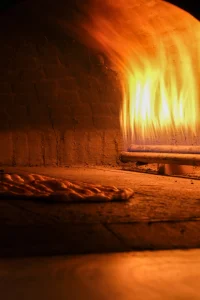
It is possible to prepare excellent baked goods in modern domestic ovens.
However, professional stone ovens capable of reaching high temperatures operate differently.
The hot surface at the base of the oven transfers heat directly to the dough.
At the same time, the high temperature inside the oven cooks the top surface.
This way, the thin dough is exposed to strong heat from both the top and bottom in a short amount of time.
This rapid cooking process plays a significant role in shaping the distinctive characteristics of pide and thin bread varieties.
Çakı Restoran Cheese Bread: Breakfast or Main Course?
Perhaps one of the finest aspects of this dish is precisely that it resists being confined to a single category.
Warm cheese bread can easily be brought to the table at morning breakfast.
At midday, it could be a satisfying choice for one.
For dinner, it can be shared as a hot starter.
This flexibility is, in fact, entirely in keeping with the character of the traditional Anatolian table.
In older kitchens, there were no sharp distinctions between “breakfast, starter, and main course” as there are on today’s restaurant menus.
The dish would arrive at the table and be shared.
Its presence at Çakı’s breakfast is no coincidence.
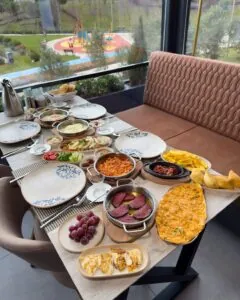
Malatya-style cheese bread is not only available as a separate item on Çakı Restoran’s Malatya menu.
The restaurant’s shared breakfast also features Regional Malatya Cheese Bread as one of the warm dishes on the table.
This aligns closely with the versatile character of the dish within the everyday Anatolian table.
A dish that can appear on the table at various times, from morning breakfast to evening dinner.
Why Do Neighbourhood Bakeries Hold Such a Firm Place in Our Memory?
A dish’s flavour alone does not determine how it is remembered.
Its aroma also lingers in the memory.
The scent of freshly baked bread from the oven is particularly powerful in this regard.
For many who grew up in Anatolia, the aroma of warm dough wafting from the neighbourhood bakery is directly associated with childhood, family, and the home table.
Perhaps this is why products such as pide, lahmacun and warm bread, even when served in restaurants, satisfy not only hunger but also another emotion.
Familiarity.
The allure of dishes such as Malatya-Style Cheesy Bread lies partly in this very aspect.
Traditional Oven Dishes: How Are They Being Incorporated into Restaurant Menus?
As urban life evolves, the traditional layouts of old neighbourhoods are also changing.
For many people, preparing food at home and sending it to the oven is no longer a daily habit.
However, the flavour of those dishes does not have to be lost.
Restaurants can carry this memory to today’s tables by recreating traditional recipes to professional kitchen standards.
What is important here is not merely to include an old dish name on the menu.
To preserve the texture of the dough, the cooking technique, and the simplicity inherent in the dish.
The role of a good regional restaurant is not always to recreate very old and complex recipes; it may instead be to preserve the flavours that, being commonplace in everyday life, have never been recorded.
Malatya-style cheese bread fits squarely into this category.
At Çakı Restoran, Malatya-Style Cheese Bread
Inspired by Malatya’s oven and bread culture, this warm delicacy can be found on Çakı Restaurant’s contemporary Malatya menu.
Malatya-style Cheese Bread is listed at 230 TL on the current online menu.
Çakı Restoran describes the dish as a cheese bread prepared with local cheeses and baked in a stone oven, featuring a crisp exterior and a softer interior.
The same Malatya menu also features regional dishes that represent a wide range of culinary techniques, such as Mahir Köfte, İçli Köfte Haşlama, Cherry Leaf Rolls and Geleli Kebab; this diversity makes the cheese bread part of a broader Malatya spread.
As menus and prices may change over time, it is advisable to check the current menu before visiting.
In Başakşehir, Discovering Anatolia’s Oven Culture
For those seeking Başakşehir Anatolian cuisine and local dishes from the Başakşehir region, it would be incomplete to assess Anatolian cuisine solely through kebabs.
This is because one of the cuisine’s greatest strengths lies in its dough and bread culture.
There is tandır bread.
There is bazlama.
There is yufka.
There is pide.
There are oily breads, cheese-based pastries, and baked goods that vary from one region to another.
Malatya-style cheese bread is likewise one of the warm and unpretentious representatives of this rich tradition.
In Başakşehir, From Breakfast to the Stone Oven: The Anatolian Table

At Çakı Restaurant, the approach of “From breakfast to kebab in Başakşehir, the leading destination for Anatolian cuisine” finds its true meaning precisely here.
Anatolian cuisine is not confined to large meat dishes served at dinner alone.
It may begin in the morning with warm cheese bread.
At midday, it may continue with a regional pastry.
In the evening, köfte, kebab and stone-oven delicacies can all be found at the same table.
The fact that Malatya-style Cheese Bread finds a place both on the restaurant’s Malatya menu and on the spread breakfast exemplifies this versatility.
For those who wish to gather with family at a long table on Istanbul’s European Side, to introduce guests from outside the city not only to Anatolia’s kebabs but also to its more everyday and intimate flavours, or to discover a variety of baked goods among Başakşehir regional dishes, such meals lend greater meaning to the menu.
For the true character of Anatolian cuisine is not always hidden in its most ostentatious dish.
Sometimes, a thin slice of cheese bread fresh from a hot stone oven is enough to tell the story of an entire neighbourhood’s culture.
Frequently Asked Questions
What is Malatya-style cheese bread?
This is a regional interpretation of bread, inspired by Malatya’s bread- and dough-making traditions, prepared with a cheese filling and baked at high oven temperatures. Çakı Restoran states that it prepares its own version using local cheeses and the stone-oven baking technique.
Is Malatya’s bread culture rich?
Yes. Traditional culinary records from Malatya mention yufka, tandır bread, sourdough bread, henna-marked bread, tablama, bazlama, oily bread, pağaç, and various other types of bread.
Are cheese bread and cheese pide the same thing?
Although similar doughs, cheeses, and oven techniques may be used, it is not correct to assume that the regional names are identical. “Malatya-Style Cheese Bread” should be evaluated in terms of its connection to Malatya’s bread culture.
Why is cheese bread baked in a stone oven?
The high and even oven temperature helps the thin dough cook quickly, gives the base a golden colour, and allows the cheese to integrate with the dough.
Is Malatya-Style Cheese Bread eaten at breakfast?
Yes. Cheese bread can be consumed at different times of the day. In Çakı Restoran’s shared breakfast spread, the Regional Malatya Cheese Bread is also included among the hot dishes.
Is Malatya Usulü Peynirli Ekmek available at Çakı Restoran?
Yes. Malatya-Style Cheese Bread is listed on Çakı Restoran’s current Malatya menu. The menu and prices may change over time.