Why Is Kayseri Mantı Made So Small?
Upon examining a plate of Kayseri mantı closely, one immediately realises that the dish’s true artistry lies not merely in its dough or its spiced minced filling.
What is truly surprising is its diminutive size.
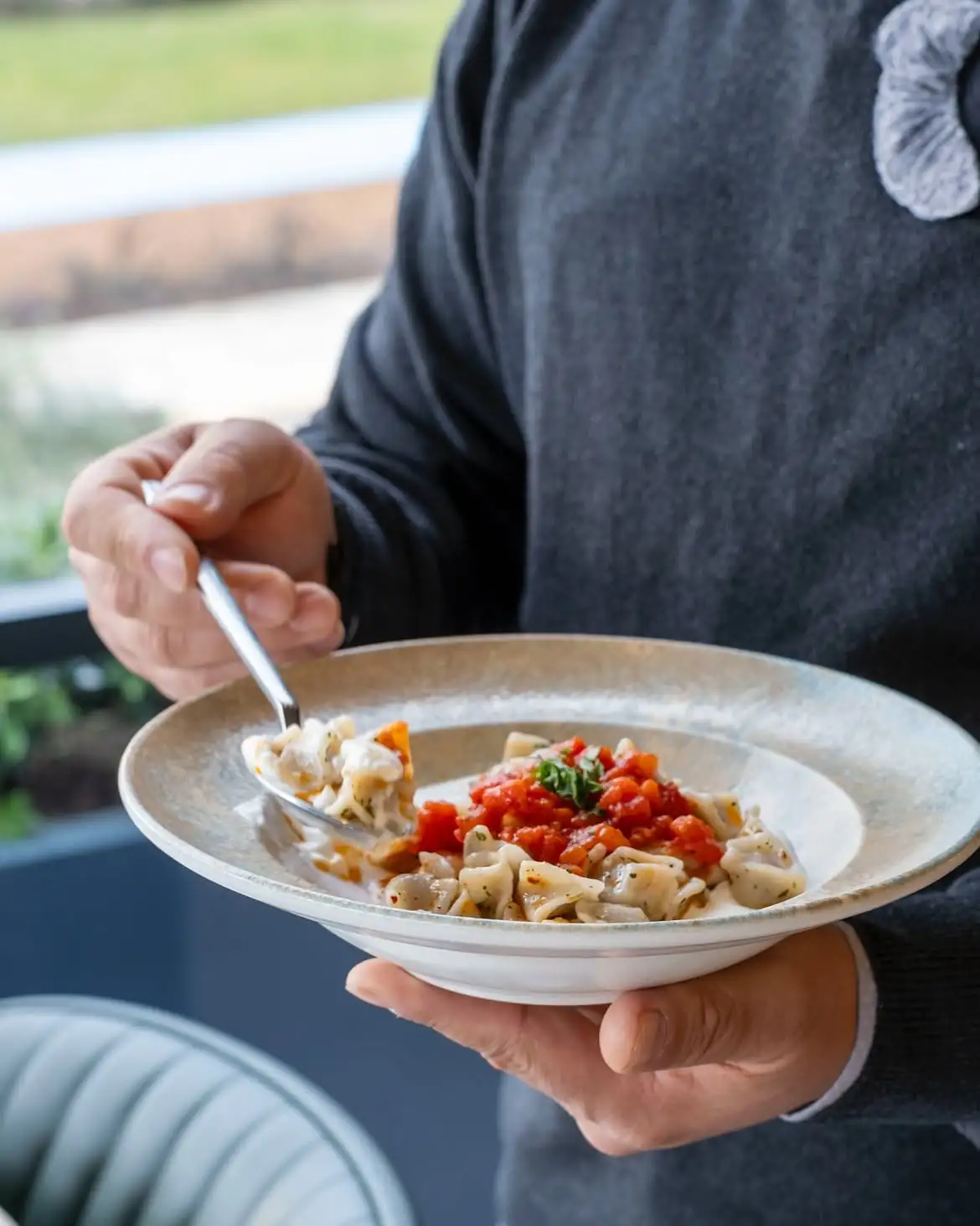
The paper-thin dough is cut into small squares. A very modest amount of spiced minced filling is placed at the centre of each piece, and the four corners are then sealed individually with the fingertips. The result is sometimes mantı so small that they are even smaller than a hazelnut.
In Kayseri, there is a well-known saying that captures this skill:
“Forty mantı should fit on a single spoon.”
Today, this saying endures as part urban legend, part measure of skill, and part expression of the pride that Kayseri’s cuisine takes in itself.
So why is Kayseri mantı made so small, where does the notion of forty mantı on a spoon come from, and how did such a tiny piece of dough become a gastronomic symbol of an entire city?
Where Does Mantı Originate?
To answer the question “Where does mantı come from?” with only a single city’s name would leave its long journey somewhat incomplete.
Mantı and similar dishes of dough filled with savoury ingredients appear in various forms across a broad region stretching from Central Asia to Anatolia.
In Turkish culinary culture, mantı boasts a rather ancient history. Historical sources indicate that similar dough-based dishes have been known for many years among communities in Central Asia and along the Silk Road.
Upon reaching Anatolia, however, mantı had not remained in a single form, but had varied from city to city.
Baked versions were made.
Boiled versions were prepared.
Fried versions emerged.
There have been variations made using large pieces of dough.
Kayseri, in turn, has developed a distinct identity within this extensive mantı family, distinguished by its small size and handcrafted nature.
How did the history of Kayseri Mantısı take shape?
The fact that Kayseri has historically been situated along significant trade routes has contributed to the development of its culinary culture under the influence of diverse traditions.
Mantı is one of the dishes that, along this lengthy culinary journey, took on its own distinctive form in Kayseri.
Historical sources pertaining to the cuisine of Kayseri indicate that written Turkish recipes for manti date back to the 15th century, and that various forms of manti were also prepared during the Ottoman period.
However, today, when we say “Kayseri Mantısı”, the image that comes to mind is quite distinct:
Tiny parcels of dough, minced meat filling, garlic yoghurt and a topping of buttery sauce.
This identity has grown so strong over time that Kayseri Mantı is now one of the regional dishes protected by a geographical indication.
Why Is Kayseri Mantı Made So Small?
The small size of Kayseri mantı is not merely an aesthetic choice.
This size is an important part of the dish’s regional identity and its culture of handcrafted skill.
Cutting the dough into small pieces, using only a small amount of filling, and closing each mantı individually demands considerable manual dexterity.
The smaller a mantı is, the more difficult it becomes to seal it properly.
For this reason, smallness in Kayseri has over time become a sign of skill.
Smaller Mantı Demand Greater Handiwork
It is not possible to prepare several small mantıs in the same time it takes to fill and seal a large piece of dough.
The dough is first rolled out thinly.
It is then divided into small squares.
A very small amount of minced meat is placed in the centre of each square.
The four corners are brought together using the fingertips.
Then the same process is repeated again and again.
When one considers that a single plate of manti contains hundreds of small pieces, it becomes clearer why this dish is one of those traditionally prepared as a family affair.
Can Forty Mantı Fit into a Single Spoon Really?
When Kayseri mantı is mentioned, one of the most frequently recounted tales is undoubtedly the saying “forty mantı to a spoon”.
It would not be accurate to regard this statement today as a definitive standard of measurement that must be applied in every Kayseri mantı establishment.
The primary meaning pertains to skill.
According to an old tradition recounted within Kayseri's culinary culture, mothers-in-law would have prospective brides make mantı in order to assess their dexterity.
The smaller and neater the prepared mantı, the greater the bride’s skill in pastry-making was deemed to be.
According to legend, a bride who could prepare mantı small enough to fit forty into a single spoon would be considered to have successfully passed this test.
The Number Forty Symbolises Skill Rather Than a Measure
Today, there’s no need to actually place forty mantı onto a spoon and count them.
The equivalent of this phrase within culinary culture is more valuable.
The small size of the mantı reflects:
Patience,
habit,
the skill of rolling out dough,
speed,
and culinary skill
These are the qualities that its small size represents.
Therefore, the tale of “forty manti per spoon” speaks not only of the size of Kayseri manti but also of the effort behind it.
In Kayseri, Why Was Mantı Traditionally Made as a Family?
Preparing mantı is not one of those dishes that a single person can complete in a short amount of time.
When it comes particularly to the small mantı prepared in the Kayseri style, an extensive preparation process precedes its arrival at the table.
One person rolls out the dough.
Another cuts it into small squares.
The minced meat is distributed.
Everyone then sits down at the dough and begins to fold the mantı.
For this reason, making mantı has never been merely a matter of preparing food; it has also been a way of coming together.
The Mantı Table Is Also a Table for Conversation

In Anatolian cuisine, some dishes acquire greater meaning when prepared in company rather than alone.
Stuffed grape leaves are one example.
Stuffed meatballs are another.
Mantı belongs to the same tradition.
Family members or neighbours gather together, and conversation continues as their hands work.
In the end, what emerges is not merely a large pot of food, but several hours spent together.
Therefore, in the memory of traditional dishes, the moment of preparation is just as important as the recipe itself.
Why Does Kayseri Mantı Have Its Distinct Shape?
Kayseri Mantısı is prepared from small square pieces of dough.
The minced filling is placed in the centre, and the four corners of the dough are brought together at the top and sealed.
This method of folding gives the manti its characteristic shape, reminiscent of a small parcel.
However, the mantı culture in Kayseri is not limited to this form alone.
The city's cuisine also features different varieties of manti.
Tepsi Mantı (Oven-Baked Dumplings)
In Tepsi Mantısı, the dough pieces are arranged in a tray, then baked or pan-fried before being served with sauce and garlic yoghurt.
Yağ Mantı (Fried Dumplings)
Kayseri Yağ Mantısı, by contrast, is a distinct interpretation: it is made with leavened dough, filled with minced meat, fried, and served with garlic yoghurt.
Purov Mantı
Kayseri’s mantı family today also encompasses distinct regional recipes such as Purov Mantısı.
This diversity demonstrates that when “Kayseri mantı” is mentioned, it refers not merely to a single dough-based dish but to a robust mantı culture.
How Is the Filling for Kayseri Mantı Prepared?
The filling of traditional Kayseri Mantı is fundamentally based on minced meat and onions.
The use of spices complements the dish’s overall character, but the essential matter is being able to place a balanced quantity of filling within each small piece of dough.
When too much minced meat is used, the mantı becomes difficult to seal.
When too little is used, the dough comes to the fore.
Consequently, even within a tiny mantı lies careful calculation of proportions.
In well-made mantı, the dough, minced meat, yogurt, and sauce each complete one another in the same bite.
Why Is Garlic Yogurt So Important in Mantı?
To regard Kayseri Mantı merely as a dish of boiled dough and minced meat would be incomplete.
Garlic yogurt is one of the dish’s fundamental characteristics.
The slight tanginess of the yogurt balances the richness of the minced meat-filled dumplings and the buttery sauce.
Garlic, on the other hand, lends a more robust flavour to this simple preparation.
Therefore, in manti, yoghurt is not merely an ordinary sauce added to the edge of the plate.
It is integral to the integrity of the dish.
How Does the Buttered Sauce Complement Mantı?
In Kayseri Mantısı, interpretations featuring butter, red pepper, or tomato paste sauce also complete the dish's character.
When the aroma of warm butter meets garlic yoghurt, the simple texture of the mantı dough becomes more pronounced.
Spices such as dried mint and red pepper provide the finishing touch.
The result is a balanced dish where dough, meat, yogurt, butter, and spices all come together in a single spoonful.
Is mantı also consumed like a soup in Kayseri?
Today, Kayseri Mantı is served as a main course in many restaurants with thick yogurt and sauce.
However, there are also accounts suggesting that in Kayseri's traditional culinary culture, mantı is prepared and consumed with more liquid.
This detail shows that the way mantı is served can also change over time.
When moving to a regional cuisine restaurant kitchen, the portion size, amount of sauce, and presentation style may change.
The fundamental identity of the dish continues to reside in the combination of dough, minced meat filling, and yoghurt.
Why is Kayseri Mantısı still so beloved today?
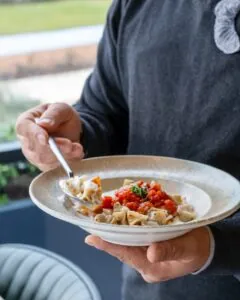
It is impossible to explain the popularity of mantı solely by its taste.
This dish has a powerful story.
On the one hand, there is a broad tradition of dough-based dishes that extends as far as the Silk Road and Central Asia.
On the other hand, Kayseri’s own home cooking.
The saying that forty mantı should fit on a spoon.
The skill of brides' hands.
Long tables where the family gathers to make mantı together.
The aroma of garlic yoghurt.
Butter-based sauce.
When all these elements come together, Kayseri mantı becomes more than merely a dish; it transforms into a reflection of the city’s gastronomic identity.
Is Kayseri Mantı Geographically Indicated?
Yes.
Kayseri Mantısı is one of the regional dishes officially protected by a geographical indication, as registered by the Turkish Patent and Trademark Office.
This registration is significant in formally safeguarding the cultural connection between mantı and Kayseri, as well as its distinctive production characteristics.
It is no coincidence that, today, when Kayseri is mentioned, mantı ranks among the first dishes that come to mind, alongside pastırma (spiced, air-cured beef), sucuk and yağlama.
Over time, its small size has become a culinary hallmark.
Kayseri Mantı at Çakı Restoran
This deeply rooted dish of Kayseri also features on Çakı Restoran’s contemporary Kayseri menu.
Kayseri Mantısı is listed at 620 TL on the current online menu.
The presence, within the same Kayseri section, of dishes representing the city’s diverse gastronomic traditions—such as Pöçlü Pide, Pastırmalı Humus, and Yağlama—allows mantı to be experienced not in isolation, but as part of a broader Kayseri table.
As menus and prices may change over time, it is advisable to check the current menu before visiting.
The Mantı Table Stretching from Kayseri to Başakşehir
In Istanbul, interest in regional cuisine is no longer confined to just a few of the most well-known kebabs.
The number of people wishing to experience the distinctive cuisine of specific cities is also on the rise.
Başakşehir Anatolian Cuisine and for anyone seeking Başakşehir regional dishes, Kayseri Mantı is precisely one such dish that embodies this character.
Because, in fact, a tiny piece of mantı contains more than just minced meat.
Kayseri’s mastery of dough-making, family tables, the tradition of sharing, and a story of skill recounted for years are also part of its heritage.
In Başakşehir, Discovering the Handcrafted Flavour of Anatolian Cuisine
Çakı Restoran’s “From breakfast to kebab in Başakşehir, the premier destination for Anatolian cuisine” ethos is further enriched by the inclusion of painstakingly crafted dishes such as Kayseri Mantı on its menu.
Anatolian cuisine is not solely composed of kebabs cooked over an open flame.
Sometimes there is meat that cooks slowly over the course of several hours.
Sometimes, dough that rises in a stone oven.
Sometimes, bulgur wrapped in a cherry leaf.
Sometimes, hundreds of tiny mantı are sealed one by one using just the fingertips.
For those wishing to gather with family at a thoughtfully laid table on Istanbul’s European side, to introduce guests from outside the city to the varied faces of Turkish cuisine, or to sample one of Kayseri’s most distinctive flavours among Başakşehir regional dishes, mantı is a familiar yet profoundly storied choice.
It is not strictly necessary to fit exactly forty into a single spoonful.
Yet, as one gazes at those minuscule mantı, it is hardly difficult to understand why the number “forty” has been invoked for so many years.
For in Kayseri Mantı, smallness is not merely a matter of size.
It is a measure of mastery.
Frequently Asked Questions
Why is Kayseri Mantı made small?
The small size of Kayseri Mantı is an integral part of the regional tradition of craftsmanship. Cutting the dough into small pieces, filling each with a modest quantity of minced meat, and sealing them one by one demand considerable manual skill.
Can forty mantı truly fit on a single spoon?
The expression “forty mantı to a spoonful” is a traditional way of describing skill in Kayseri’s mantı-making. It should not be regarded as a precise portion or production standard, but rather as a cultural yardstick for how finely and meticulously the mantı can be prepared.
Where does the story of forty mantı in one spoon come from?
According to accounts from Kayseri's culinary culture, in the past, mothers-in-law would have prospective brides make mantı to test their dexterity; a bride who could prepare mantı small enough to fit forty pieces on a single spoon was considered skillful.
Where is mantı from?
The origins of mantı and similar filled-pastry dishes are linked to a broad geographical expanse stretching from Central Asia to Anatolia. Within Turkey, Kayseri is among the cities most closely associated with mantı.
Is Kayseri Mantı a protected geographical indication?
Yes. Kayseri Mantı was registered as a geographical indication on 10 June 2009, with registration number 113.
What is served on top of Kayseri mantı?
In traditional presentations, garlic yoghurt is one of the essential accompaniments. Butter, red pepper flakes, tomato paste sauce, or dried mint can also be used when serving mantı.
Are there other varieties of mantı in Kayseri?
Yes. In addition to the classic meat-filled mantı of Kayseri cuisine, there are also other varieties such as Tepsi Mantısı, Yağ Mantısı and Purov Mantısı.
At Çakı Restoran, do they serve Kayseri mantı?
Yes. Kayseri Mantı is currently featured on Çakı Restoran’s Kayseri menu. It is listed on the current online menu. Menu items and prices may change over time.