
A Winter Tradition Served with Tahini and Walnuts
How does a vegetable become a dessert?
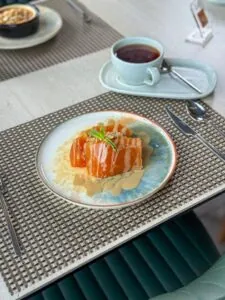
One of the finest dishes of Anatolian cuisine is pumpkin dessert.
At first glance, pumpkin might be thought of as an ingredient for soups, main dishes, or stuffed vegetables. However, in Turkish cuisine, when this seasonal vegetable is slowly cooked with sugar, it acquires a completely different character.
Chopped walnuts are sprinkled over it in some places.
Some versions are finished with a drizzle of tahini.
Elsewhere, it is served with kaymak, a rich clotted cream.
The result is a simple dessert with a distinctive flavour.
Therefore, the history of pumpkin dessert is not merely the story of a recipe’s origins, but also a narrative of Anatolia’s seasonal culinary philosophy, its tradition of making the most of local produce, and a table culture that effortlessly transcends the boundaries between sweet and savoury.
Kabak Tatlısı—A Delicacy of Which Region?
It wouldn't be right to answer the question "Where is pumpkin dessert from?" with just one city name.
Pumpkin dessert is one of the traditional sweets that has been prepared for a long time in various regions of Anatolia. In the regional cuisine records of the Ministry of Culture and Tourism, recipes for pumpkin dessert and similar pumpkin-based sweets can also be found in different cities.
This situation demonstrates something important:
Pumpkin dessert is not so much a single recipe confined to the boundaries of a particular city as it is part of a broad tradition with regional variations under the heading of pumpkin dessert in Turkish cuisine.
In one city, walnuts take centre stage.
Elsewhere, it is tahini.
At another table, clotted cream.
While the core idea remains the same, the culture of presentation varies according to geography.
The Place of Pumpkin in Anatolian Cuisine
In Anatolian cuisine, pumpkin is not used solely as a sweet.
It also finds its place in soups, pot dishes, börek and other pastries, jams, and various regional recipes.
This diversity demonstrates just how versatile a product pumpkin is in the kitchen.
Its durable nature, which allows it to be stored for long periods in cool conditions, also makes it particularly valuable in winter cooking.
Why is seasonality so important?
Traditional Anatolian cuisine did not develop within a system in which every product was available year-round, as is the case today.
The seasons determined the contents of the table.
Different vegetables were prepared in summer.
Drying began in autumn.
During the winter months, hardy vegetables, grains, dried products, and winter provisions featured more prominently on the table.
Pumpkin was precisely one of the standout products at this point.
Pumpkin, which ripens during the autumn and winter months, has become one of the familiar flavours of cold-weather tables thanks to its ability to be stored for long periods and also transformed into desserts.
How Can a Vegetable Become a Sweet?
This is one of the fundamental questions that makes pumpkin dessert interesting.
Although pumpkin is perceived as a vegetable both botanically and in culinary use, it naturally contains a certain amount of sugar.
During the long and controlled cooking process, its texture softens.
It releases its liquid along with the sugar.
The result is a dense, glossy texture that is almost fruity in character.
The aim of pumpkin dessert, therefore, is not to alter the pumpkin’s natural character entirely.
Rather, it is to intensify it.
Vegetables in Anatolian Desserts: A Long Tradition
Pumpkin dessert may seem surprising when one considers that vegetables in Turkish cuisine are generally thought to be used only in savoury dishes.
Anatolian cuisine, however, is remarkably flexible in this regard.
Fruits may be incorporated into meat dishes.
Pekmez can be used with vegetables.
Apricots may be paired with meat.
And pumpkin can be transformed into a dessert.
This approach demonstrates that much older examples of what modern gastronomy refers to as the “balance of sweet and savoury” can be found on Anatolian tables.
What Cooking Logic Underlies Pumpkin Dessert?
The ingredients list for pumpkin dessert is generally quite simple.
Pumpkin.
Sugar.
Sometimes very little water.
The main issue is the cooking technique.
The Tradition of Resting the Pumpkin in Sugar
In traditional recipes, it is a common practice to allow pieces of pumpkin to sit with sugar for a period of time.
Over time, the sugar begins to draw out the moisture from the pumpkin.
This way, the pumpkin can cook more controllably in the liquid it releases.
This method helps to soften the dessert while preserving its shape, without crushing the pumpkin.
Why Is Slow Cooking Important?
When pumpkin is cooked too quickly over high heat, the outside may soften before the inside is evenly cooked.
Cooking over low or medium heat allows for greater control, enabling the sugary liquid to gradually infuse into the pumpkin.
The aim of a well-made pumpkin dessert is not to reduce the pumpkin entirely to a purée.
It should be tender when pierced with a fork, yet retain its shape when served.
What Gives Pumpkin Dessert Its Colour?
The pumpkin’s distinctive orange hue deepens during cooking.
When simmered with sugar for an extended period, its surface may develop a glossy, lightly caramelised appearance.
Certain regional methods also employ different techniques to alter the dessert’s texture and colour.
For instance, there are distinct traditional interpretations, such as pumpkin jam, in which the pumpkin is firmer and has a different exterior texture, or pumpkin preserved in lime.
In the classic pumpkin dessert, however, its defining characteristic is the softening of the pumpkin while preserving its own texture.
Why Does Walnut Complement Pumpkin Dessert So Well?
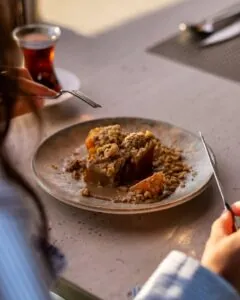
The soft, sugary texture of the pumpkin dessert is contrasted strikingly by the walnuts, which provide a distinct textural counterpoint.
On one side, soft pumpkin.
On the other side, crunchy walnuts.
The walnuts’ slightly bitter, rich flavour balances the sweetness of the dessert.
Therefore, walnuts are not just for decoration.
They are part of the dish’s balance of flavours.
The Place of Walnuts in Anatolian Desserts
Walnuts have an extremely wide range of uses in Anatolian cuisine.
It can be found in many recipes, from baklava to halva, from kome to pestil, and from pastries to fruit desserts.
Its pairing with pumpkin is also one of the natural outcomes of this widespread culture of use.
What Does Tahini Add to Pumpkin Dessert?
In certain regional and modern presentations of pumpkin dessert, tahini is a significant accompaniment.
The tahini, with its rich sesame flavour and oily texture, balances the sweet character of the pumpkin.
At the same time, it gives desserts a creamier and more substantial mouthfeel.
What is interesting about this pairing is that the two ingredients have rather different characters.
The pumpkin is sweet and soft.
Tahini is thick, slightly astringent and flavoured with sesame.
When used together, the dish ceases to be one-dimensional in flavour.
Are Tahini and Walnuts Used Together?
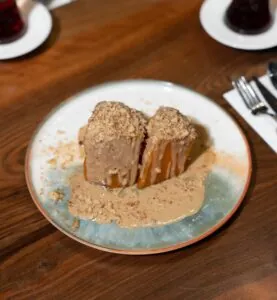
Yes.
In pumpkin dessert, tahini and walnuts are frequently combined on the same plate.
Tahini lends richness and density.
Walnuts provide a crisp texture.
The pumpkin, meanwhile, forms a sweet and tender base between the two.
This trio has become one of the most beloved ways of serving pumpkin dessert.
Why Does Kaymak Complement Pumpkin Dessert?
Kaymak creates a different kind of balance.
The dense, sugary character of pumpkin dessert is softened by kaymak’s milky and creamy texture.
Especially when eaten with the dessert’s syrup or its natural juices, kaymak brings greater balance to the palate.
As with many other desserts across Anatolia, therefore, kaymak in pumpkin dessert is not merely a luxurious addition.
It is a companion that balances the flavours.
Walnuts, Tahini, or Kaymak?
There is no single correct answer to this question.
Because the beauty of pumpkin dessert lies partly in its openness to regional and personal preferences.
Walnuts provide a more traditional and crunchy character.
Tahini provides a richer and distinct flavour.
Kaymak, on the other hand, establishes a milky and soft balance.
On some tables, two or all three may be used together.
The important thing here is that the pumpkin does not completely lose its own flavour.
Why Has Pumpkin Dessert Become Associated with Winter Tables?
The pumpkin's harvest season and its storability naturally align it with autumn and winter cuisine.
In cold weather, following hot dishes from the oven or the pot, pumpkin dessert offers a more seasonally appropriate sense of closure.
Especially at traditional family tables, it is entirely natural for the culinary sequence to move from dishes prepared with winter produce to a dessert made from ingredients of the same season.
Although pumpkin dessert is now served in restaurants at various times of the year, its place in memory remains largely tied to winter tables.
Is Pumpkin Dessert a Syrup-Sweetened or a Milk-Based Sweet?
In fact, neither is quite right.
Pumpkin dessert can be regarded as belonging to its own distinct category of fruit and vegetable desserts.
It is not a pastry such as baklava.
Nor is it milky, like süt helvası or muhallebi.
The sugar combines with the pumpkin’s own moisture to create a natural sweet sauce.
Consequently, it possesses a different character when compared with heavily syrup-soaked desserts.
After Süt Helvası, Why Does Pumpkin Dessert Make Such a Pleasant Comparison?

Süt helvası (milk dessert) is a dessert made from milk, flour and sugar, slowly prepared over heat.
Pumpkin dessert, by contrast, is shaped by seasonal produce, sugar and gentle, prolonged cooking.
Both desserts are part of traditional Turkish cuisine, yet they represent entirely different culinary ideas.
One embodies the culture of milk and roasting.
The other reflects the tradition of transforming seasonal vegetables into something sweet.
This diversity beautifully demonstrates that Anatolian dessert culture extends far beyond baklava and syrup-soaked pastries.
Why Does Pumpkin Dessert Remain Beloved in Turkish Cuisine?
The strength of pumpkin dessert lies largely in its simplicity.
It requires no complicated techniques.
Nor does it call for numerous ingredients.
The right pumpkin, the right amount of sugar and patience are all that are needed.
This simplicity also brings the dish closer to the family kitchen.
For many people, pumpkin dessert is far less an exotic treat discovered in restaurants and far more a familiar flavour prepared at home by the elders.
This sense of familiarity is one of the elements that has ensured its survival across generations.
Why Traditional Desserts Matter on Restaurant Menus
When a restaurant attempts to represent Anatolian cuisine solely through its main courses, the story remains incomplete.
Because culinary culture is completed with something sweet.
Halva.
Baklava.
Pumpkin dessert.
Höşmerim.
Desserts with pekmez.
Fruit desserts.
Each of these reflects a different region, technique, or season.
Therefore, including traditional desserts on a restaurant menu is not merely about offering a “sweet option”.
It sustains the cultural continuity of the table.
At Çakı Restoran, Kabak Tatlısı
This traditional Anatolian dessert is also featured on Çakı Restoran’s current dessert menu.
Çakı Restoran serves Pumpkin Dessert as a traditional sweet, finished with walnuts.
The price of this item is listed in the restaurant’s desserts section on its current online menu.
The presence on the same dessert menu of Süt Helvası (milk dessert), Wedge-Cut Baklava, Çakı Pistachio, San Sebastián, and Maraş Kesme Ice Cream—each with its own character—brings together traditional Anatolian desserts and more contemporary sweet interpretations at the same table.
As menus and prices may change over time, it is advisable to check the current menu before visiting.
Discovering Anatolian Dessert Culture in Başakşehir
For those seeking Başakşehir Anatolian Cuisine or Başakşehir regional dishes, Anatolian cuisine does not end when the main course is finished.
Because the dessert at the end of the meal also tells the story of the table's identity.
Following kebabs and meat dishes, a syrup-soaked baklava may be chosen.
For a more milky conclusion, one may move on to süt helvası (milk dessert).
When seeking a seasonal and simpler sweetness, pumpkin dessert offers a wholly different option.
This variety makes it possible to experience Anatolian cuisine without confining it to a single flavour profile.
In Başakşehir, an Anatolian Spread from Breakfast to Dessert
Çakı Restoran’s approach—“From breakfast to kebab in Başakşehir, the leading destination for Anatolian cuisine”—also makes sense when one looks at its dessert menu.
An Anatolian table does not begin with meat alone, nor does it end with kebab.
There is a broader culinary culture that extends from breakfast to stone-oven products, from regional main courses to milky and seasonal desserts.
For those wishing to gather with family at a warm and carefully prepared table on Istanbul’s European Side, to show visitors from outside the city the different facets of Turkish cuisine, or to discover traditional desserts among the regional dishes of Başakşehir, pumpkin dessert is a natural part of this wholeness.
For Anatolian cuisine sometimes reveals its most surprising transformation through its simplest ingredient.
A vegetable goes into the pot.
It is cooked slowly with sugar.
It is served with a few pieces of walnut.
And so a vegetable becomes the dessert that completes the meal.
Frequently Asked Questions
Where does pumpkin dessert originate?
It is not accurate to attribute pumpkin dessert to a single city. It is one of the traditional Turkish desserts prepared in various forms across different regions of Anatolia.
How far back does the history of Pumpkin Dessert extend?
There is no reliable single date indicating when pumpkin dessert first appeared. However, it is known that pumpkin has long been used in Anatolia’s seasonal cuisine and that pumpkin desserts cooked with sugar feature in various regional cuisines.
Why is Pumpkin Dessert left to rest with sugar?
The sugar assists in drawing out the pumpkin’s natural moisture. This enables the dessert to make use of the pumpkin’s own liquid during cooking, resulting in a more concentrated flavour.
Why is Pumpkin Dessert cooked over a gentle heat?
Controlled, slow cooking helps soften the interior of the pumpkin, allows the sugar to infuse evenly, and enables the pieces to retain their shape without fully disintegrating.
What is added to pumpkin dessert?
Walnuts are among the most common accompaniments. Depending on regional and personal preferences, tahini, clotted cream, or other nuts may also be used.
Does tahini suit pumpkin dessert?
Yes. Tahini’s rich sesame flavour and oily texture balance the pumpkin’s sweet character. It is particularly often served alongside walnuts.
Is pumpkin dessert a winter sweet?
Owing to the pumpkin harvest season and its ability to be stored for long periods, pumpkin dessert is traditionally closely associated with autumn and winter tables.
At Çakı Restoran, do they serve pumpkin dessert?
Yes. Pumpkin Dessert is currently included in Çakı Restoran’s dessert menu. The restaurant serves the dish accompanied by walnuts. As current pricing and presentation details may change over time, it is advisable to check the menu before visiting.