A Prized Cut in Gaziantep’s Kebab Tradition
To appreciate certain cuts of meat, merely tasting them is insufficient. One must also know from which part of the animal they come, why they are scarce, and how they should be cooked.
Küşleme is precisely such a cut of meat.
The question most frequently asked by those hearing the term for the first time is quite simple:
From which part of the animal does küşleme come?
Küşleme is an exceptionally small and tender piece of meat found on either side of the lumbar vertebrae in the loin region of a lamb. Only two such pieces can be obtained from a single lamb, and the total quantity is extremely limited.
For this reason, küşleme is not an ordinary cut of meat.
It is rare.
It is boneless.
Its fat content is low.
When cooked correctly, however, it offers an exceptionally tender texture.
This is precisely why küşleme holds a distinct place within Gaziantep’s kebab culture.
What is lamb tenderloin?
Küşleme, known colloquially as lamb tenderloin, is a special cut of meat.
The geographical indication registration for Gaziantep Küşleme Kebabı states that the küşleme is taken from the middle of the lamb’s back, from either side of the backbone.
Only two portions of lamb tenderloin can be obtained from a single lamb.
Each piece is approximately two finger-widths thick, 17–18 centimetres long, and weighs 150–200 grams.
This information clearly explains why lamb tenderloin is considered a rare and prized cut of meat.
Where Is Küşleme Located on the Animal?
Lamb tenderloin is found in the loin and back region of the lamb.
It is taken from the small muscles located on either side of the backbone.
Because this muscle region sees little activity during the animal’s daily movements, it contains less connective tissue compared with other muscle groups.
Consequently, lamb tenderloin (küşleme) has a smooth, tender texture.
Is Küşleme Lamb Tenderloin?
In culinary usage, the term “lamb fillet” is often applied to lamb tenderloin (küşleme).
This is because its texture resembles that of beef fillet and it comes from a small muscle group.
However, in this case the meat in question is lamb.
The term “lamb fillet” may therefore be regarded as a practical equivalent for describing lamb tenderloin (küşleme).
How Much Küşleme Can Be Obtained from a Single Lamb?
One of the most important factors that make lamb tenderloin (küşleme) special is its scarcity.
A single lamb does not yield dozens of portions of lamb tenderloin (küşleme).
There are only two pieces, one on each side of the back.
According to the geographical indication registration, each piece weighs approximately 150–200 grams.
This also means that only a rather limited quantity of lamb tenderloin can be obtained from a single lamb in total.
This is one of the reasons why meat is held in high regard.
It is a small, special cut rather than a large muscle that yields substantial quantities of meat.
Why Is It So Limited?
Lamb tenderloin is not a large muscle in the animal's anatomy.
It occupies a small and limited area on either side of the backbone.
Therefore, it must be carefully separated during the butchering process.
This also makes the lamb tenderloin (küşleme) more exceptional, both in terms of quantity and craftsmanship.
Why Is Küşleme So Tender?
One of the primary factors determining the tenderness of meat is the extent to which the muscle has been used throughout the animal’s life.
Heavily worked muscles may have denser connective tissue.
The lamb tenderloin (küşleme), on the other hand, is a relatively less-used muscle group.
It therefore contains less sinew and connective tissue.
As a result, a tender meat texture can be achieved without the need for hours of cooking.
This feature takes lamb tenderloin (küşleme) to a completely different level compared to meats that require long cooking times, such as tandır lamb.
Is Küşleme Cooked for a Long Time?
No.
To preserve the natural tenderness of the lamb tenderloin (küşleme), long cooking times are generally not preferred.
In the registered preparation method of Gaziantep Lamb Tenderloin (Küşleme) Kebab, the meat is cut into large pieces, seasoned with a little salt and olive oil, and then cooked over glowing embers on a grill, being turned to cook all four sides.
The ideal cooking level is also specified as medium.
The aim of this approach is to create a strong barbecue flavour on the surface of the meat without completely drying it out.
Why Is Küşleme Cooked at High Heat?
One of the most important considerations when cooking tender cuts of meat is controlling moisture loss.
If lamb tenderloin is left on a low heat for an extended period, it may lose its natural juices.
A short period of controlled high heat allows the exterior to develop colour while helping the interior to remain juicier.
For this reason, the correct preparation of the embers is of paramount importance in küşleme kebab.
Embers, Not Flames
The traditional recipe for Gaziantep Küşleme Kebab specifically states that flaming barbecue coals should not be used.
The coals must be reduced entirely to embers.
Once the flames have died down, the skewers are placed on the barbecue.
This allows the meat to cook with controlled high heat, without being scorched directly by the flames.
This method is one of the fundamental principles of good kebab-making.
Why Are Spices Used Sparingly in Küşleme?
Küşleme is not a cut of meat that needs to be overwhelmed by strong spices.
The ingredient list for the protected Gaziantep Küşleme Kebab is surprisingly simple:
Küşleme.
Salt.
Olive oil.
No other spice mixture should be used.
The reason for this is to preserve the meat's natural texture and aroma.
When using a good cut of meat, the aim is not to alter its flavour, but to bring it out through proper cooking.
Does Good Meat Require Extensive Processing?
Not always.
Lamb tenderloin is one of the finest examples of this.
Rather than relying on robust marinades, lengthy lists of sauces, or heavy spice blends, the meat’s own character is given centre stage.
This approach actually demonstrates one of the key principles of Anatolian kebab craftsmanship:
If the ingredients are good, the kitchen will not hide them.
Where Does Küşleme Kebabı Originate From?
Although lamb tenderloin (küşleme) is a cut of meat known across various regions of Turkey, Küşleme Kebab is particularly and strongly associated with the cuisine of Gaziantep.
Gaziantep Küşleme Kebab / Antep Küşleme Kebab was officially registered as a geographical indication by the Turkish Patent and Trademark Office on 9 February 2021, under registration number 664.
This registration formally affirms the cultural connection between küşleme kebab and the cuisine of Gaziantep.
Why Is the Cut of Meat Important in Gaziantep’s Kebab Culture?
In the kebab culture of South-eastern Anatolia, simply saying “lamb meat” is often insufficient.
It is important to know which part of the animal is used for which dish.
Some kebabs make use of minced meat.
Others use ribs or breast.
Still others use leg meat.
In küşleme kebab, however, preference is given to this small, tender cut from the inner part of the back.
This choice directly determines the character of the dish.
Because a good kebab requires not only mastery of the fire, but also the knowledge of pairing the right cut of meat with the right technique.
Is Küşleme the Same as Lamb Skewers?

No.
Although both dishes can be prepared similarly on a skewer or over an open flame, the cut of meat used may differ.
Lamb skewers can be made with diced meat prepared from different cuts of lamb.
In küşleme kebab, the particularly limited and tender cut known as küşleme is used exclusively.
Consequently, the texture of küşleme may differ from that of classic lamb shish.
What is the difference between küşleme and Lamb Chops?

Lamb chops are prepared from the bony cuts along the ribcage and back.
Küşleme, by contrast, is the small, boneless and sinew-free section of meat situated on either side of the lumbar vertebrae.
While in chops the combination of bone, fat and meat forms an essential part of the flavour, küşleme offers a more straightforward and direct meat experience.
The fact that both cuts come from the same lamb does not mean that they should be cooked in the same way.
Each cut of meat requires its own technique.
Why is lamb tenderloin (küşleme) one of the cuts of meat that showcases kebab mastery?
Because küşleme demands minimal intervention, there is little room for error in the kitchen.
If the meat is not of good quality, this will be noticeable.
If the embers are not right, it can be felt.
If overcooked, it may lose its tenderness.
If it is undercooked, the desired barbecue character may not develop.
Therefore, in preparing lamb tenderloin, the chef’s or kebab master’s task is far less about transforming the meat and far more about preserving its natural character.
Cutting
The pieces should be of a balanced size.
Threading the Skewers
The pieces should be spaced on the skewer so that heat can reach every surface.
The Embers
Flameless and evenly distributed embers should be used.
Cooking
The meat must be checked continuously and turned evenly on all four sides.
Beneath the simplicity of lamb tenderloin lies, in fact, such precise culinary expertise.
How Is Küşleme Served?
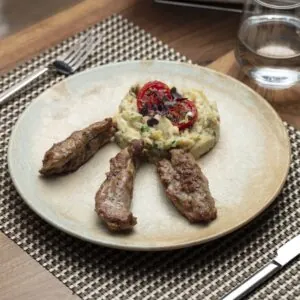
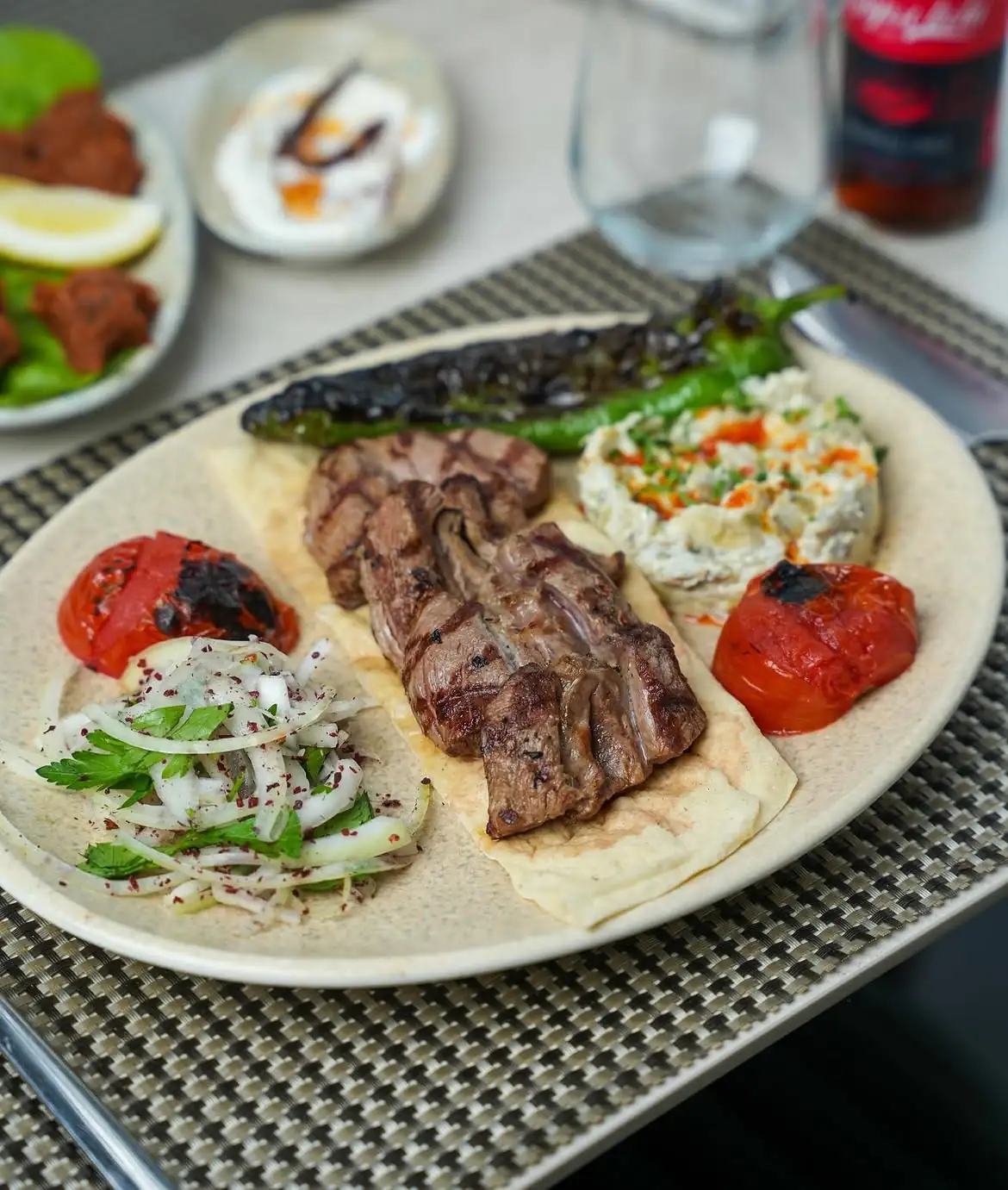
The traditional presentation of registered Gaziantep Küşleme Kebab includes thin pide bread, parsley-and-onion salad (piyaz), roasted peppers and tomatoes.
These accompaniments are not chosen at random.
The pide absorbs the juices of the meat.
The parsley-and-onion salad provides a refreshing contrast.
The roasted peppers and tomatoes, meanwhile, carry the barbecue aroma through to the rest of the table.
Thus, while the lamb tenderloin (küşleme) remains at the centre of the plate, the surrounding elements complete the dish.
At Çakı Restoran, Küşleme
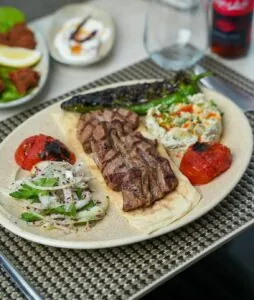
This particular cut of lamb also features on Çakı Restoran’s current main-course menu.
Çakı Restoran describes Küşleme as one of the most prized and tender parts of lamb, presenting it simply so that the meat’s natural character takes centre stage.
On the current online menu, Küşleme is listed at 1,590 TL.
The fact that the same main-course menu features options representing different cuts of lamb and various cooking techniques—such as Kuzu Şiş, Kuzu Pirzola, Kuzu Sırt Lokum, Kuzu Tandır and Kuzu İncik—offers meat enthusiasts a rather intriguing opportunity for comparison.
As menus and prices may change over time, it is advisable to check the current menu before visiting.
Başakşehir — Discovering Küşleme and Anatolian Meat Traditions
For anyone seeking Başakşehir Anatolian cuisine or traditional dishes from the Başakşehir region, assessing the local meat culture solely through kebab names would be incomplete.
Which cut of meat is used is just as important as the cooking method itself.
Lamb tenderloin (küşleme) is one of the finest examples of this.
On one side is Kuzu Tandır, which is slow-cooked until its fibres fall apart.
On the other is Küşleme, prepared over embers in just a few minutes.
Although both are made from lamb, their culinary approaches are entirely different.
The richness of Anatolian cuisine lies partly in this very knowledge.
A More Modest Side of Meat Mastery in Başakşehir
Çakı Restoran’s approach—“from breakfast to kebabs in Başakşehir, the leading destination for Anatolian cuisine”—can be discerned not only from its variety of dishes but also from its inclusion of different cuts of meat and cooking techniques within the same menu.
The presence on a single table of Küşleme, a dish that should be prepared simply; Kuzu Tandır, which requires long cooking; Söğürme Kebabı, a recipe with a pronounced charred character; and Kuzu Pirzola, a bone-in cut—demonstrates the diverse facets of Anatolian meat culture.
For those wishing to gather with family at a thoughtfully laid table on Istanbul’s European side, introduce guests from out of town to distinct Turkish meat and kebab traditions, or explore the more exceptional cuts of lamb among Başakşehir regional dishes, Küşleme offers a particularly compelling choice.
For sometimes, what determines the value of a cut of meat is not its size.
On the contrary, it is the fact that only two small portions can be obtained from a single lamb.
Frequently Asked Questions
What is küşleme?
Küşleme is a small, lean, and sinew-free cut of meat taken from either side of the lumbar vertebrae in the lamb’s back region; it is also known as lamb tenderloin.
Where on the lamb is küşleme found?
Küşleme is located in the centre of the lamb’s back, on either side of the lumbar vertebrae. Only two portions of küşleme can be obtained from each lamb.
How much küşleme is obtained from a lamb?
According to the definition of Geographically Indicated Gaziantep Küşleme Kebabı, two portions of küşleme are obtained from a lamb. Each portion weighs approximately 150–200 grams.
Why is küşleme tender?
Küşleme is naturally very tender because it comes from a muscle that sees little use and has a low connective-tissue content.
How is küşleme cooked?
In Gaziantep’s registered method, the küşleme is prepared in large pieces with a light seasoning of salt and olive oil, threaded onto skewers, and cooked over embers without open flame, turning all four sides.
To what degree should küşleme be cooked?
The geographical indication specification for Gaziantep Küşleme Kebabı states that the ideal degree of doneness is medium.
Küşleme Kebabı originates from where?
Küşleme Kebabı is particularly associated with Gaziantep cuisine. Gaziantep Küşleme Kebabı / Antep Küşleme Kebabı is registered under a geographical indication.
Are spices added to küşleme?
According to the registered Gaziantep recipe, küşleme is prepared with salt and olive oil only. Due to the meat’s natural flavour, no strong spices are used.
Does Çakı Restoran Serve Küşleme?
Yes. Küşleme is included in Çakı Restoran’s current main courses menu and is listed on the up-to-date online menu. Menus and prices may change over time.